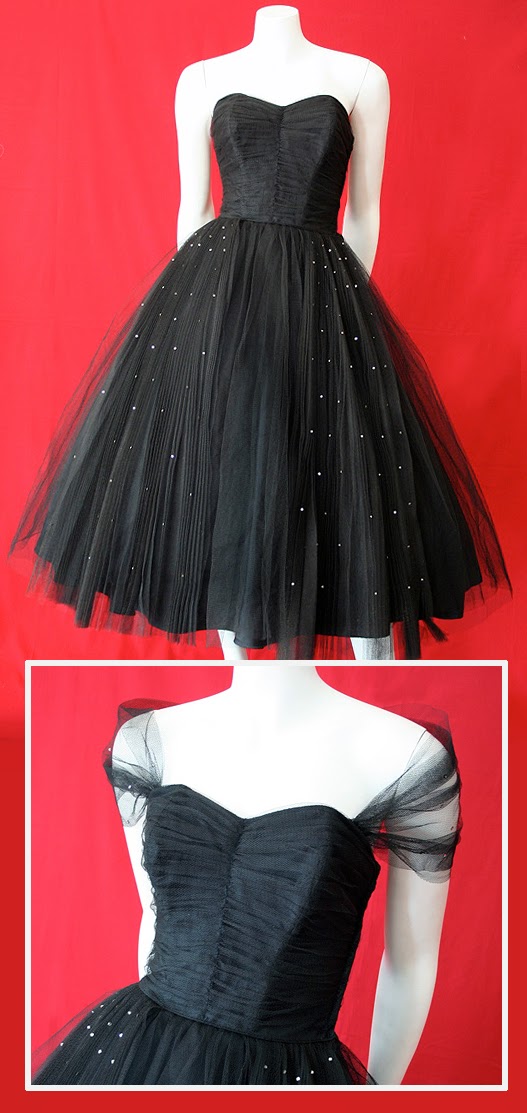
Inspired by the beautiful gowns worn by Angelina Jolie and Jennifer Garner to the 2013 Governors Awards in Hollywood recently (shown in my last post) I decided to show all the beautiful vintage 1950s LBDs I have for sale on vintageclothing.com.au
They never cease to delight me and the styles are timeless ... and of course at a fraction of the cost you would pay today for the same dress.
I hope you enjoy them.
Vintage 50s at its best. Original black and silver halter-neck, backless wiggle dress. The quality striped fabric is textured and has a slight sheen. Just add a fabulous black hat or fascinator. I am a bit partial to the bigger brimmed hats for that knockout look. You will be ready for Derby Day.
I always think a vintage wedding dress is a great idea to make a statement on your big day. Also so much cheaper than something you'd find in the shops. I've added a selection from vintageclothing.com.au
As Riley (a dress historian at the State Library of NSW) says: “Dressmaking and fashion are portable trades,
and with the great waves of migration around the world over the past
century, if someone had skill in a certain area, it was embraced no
matter where they were.” And Australia is no exception, particularly
with the influx of European migrants in the 1950s that saw a boom in
dressmaking. Along with European food and culture came couture, or at
least a version of it. During the 20th century, workers and
dressmakers came to Australia and set up fashion businesses, with
fabrics and patterns brought from Europe. Two women, Paulette Pellier
and Germaine Rocher, are widely noted as integral to establishing a
couture industry in Australia. Pellier, previously a Paris-based
dressmaker, migrated to Australia during World War I and set up her own
studio in Sydney offering pin-tucked, hand-embroidered blouses, which
she also sold out of a Brisbane hotel room through the 1920s in a
similar format to French houses’ salon shows. The 1930s saw Rocher and
her husband escape Bolshevik Russia and arrive in Sydney with two French
seamstresses, with whom she created a workroom in the elegant St James
Trust Building. Rocher travelled to Paris every year where “she had
relationships with the couturiers and was friendly with Balenciaga,”
says Riley. “She was very stylish and was noted for the beautiful
clothing she offered.” Jones believes Australians suffered
something of a cultural cringe as a result of the great distance between
them and Europe. This was to be a contributing factor in our love of
magazines, seen as a connection to the rest of the world. In 1946, the Australian Women’s Weekly sent
its fashion editor, Mary Ursula Hordern, to Paris to report on the
haute couture collections. There, she put together a collection of over
100 pieces for a Sydney-based fashion show and, while Australians
couldn’t purchase from the collection, it stimulated fervent shopping
and kick-started Australia’s garment industry following the war’s
depression. “It really hit a nerve with Australians, seeing the
whole package: haute couture on French models,” says Riley, explaining
the sheer saturation it achieved as a newsreel of the show was screened
in every Australian cinema. So successful was it that European houses
began to identify Australia as a viable market for their goods and so
licensing agreements were established between the likes of Christian
Dior and department store David Jones. Pierre Balmain, another famous
French couturier, visited Australia in 1947, creating a collection
exclusively for David Jones. A decade later, rival store Myer brought
the first all-Dior fashion parade to Australia, making the French
couturier a household name. However, as Katie Somerville, curator
of Australian fashion and textiles at the National Gallery of Victoria,
points out, Australian fashion hasn’t always been about what was made
overseas. “Labels and dressmakers developed in their own right and were
very much a product of Australia,” she says, noting the cascade effect
of French haute couture that inspired many Australian fashion houses to
offer a couture service. Jones agrees with Somerville, noting the likes
of Chris Jacovides, Hall Ludlow and Beril Jents as key initiators in
Australia establishing its own identity for couture. Jents had
originally visited the fashion shows in Paris in the 1940s, having been
asked to copy the patterns for the local market, but later set up her
own studio and began creating clothes under her own name. “There were some very wealthy women who wanted to look good for the ball season’s social scene,” says Jones.
“They loved fashion and getting dressed up.” Of course, much of the
high glamour subsided with the informality of the 1960s but couture
remained an integral part of the Australian fashion industry.
I would love to hear from anyone with their stories on Australian fashion
Am seeing pretty floral dresses everywhere at the moment so thought I would share the lovely genuine 1950 vintage floral dresses I have for sale on vintageclothing.com.au
You won't spot any of these anywhere else.
I always get excited when I come across a gorgeous Australian-made vintage piece.
This original 1950s, pure wool, 2 pce outfit carries the David Jones label.
It was given to me by a dear friend whose stylish mother originally owned it.
I have listed it for sale on my website vintageclothing.com.au and hope it goes to a good home.
It is in a very desirable modern day size 12 also.
Hello. I live in Brisbane, Australia and have started this blog to share my passion for beautiful clothes, new and old. I have a vintage clothing website vintageclothing.com.au that enables me to buy and sell some rare and wonderful items of clothing. Also to share them with you. Hope you enjoy my posts and would love to hear your opinions.